History of Artificial Intelligence
Published: 3 Oct 2025
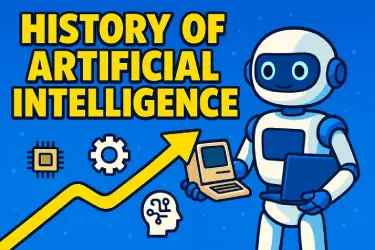
1. Introduction
Artificial Intelligence, also called AI, is the science of making machines think and act like humans. Today, we see AI everywhere. It answers our questions, drives cars, and even creates art. But this powerful technology did not appear overnight. It has a long and fascinating history.
In this article, you will learn how Artificial Intelligence (AI) began, who made the first smart machines, why it stopped growing for some time, and how it became powerful again.
We will also see how Artificial Intelligence (AI) helps us in daily life and how it may change our world in the future. So, let’s begin the story of Artificial Intelligence. Are you ready to travel back in time and explore how machines learned to think?
Table of Contents
2. The Early Ideas of Artificial Intelligence
The dream of creating machines that could think is not new. It goes back thousands of years. Long before computers, people imagined artificial beings that could move, talk, or even make decisions. These early ideas shaped the foundation of Artificial Intelligence.
Ancient Myths and Stories
In ancient Greece, myths spoke of robots made by the gods. One famous story is about Talos, a giant bronze man who guarded the island of Crete. He was not human, but he could walk and protect the land. In Hindu stories from India, there are also tales of mechanical men created by skilled inventors. These stories may sound like fantasy, but they show how humans always dreamed of intelligent machines.
Philosophers and Logic
As time moved on, philosophers began to ask: Can human thought be explained with rules? Aristotle, a Greek philosopher, created systems of logic more than 2,000 years ago. His work was important because logic is the foundation of computer science and AI today. Later, in the 17th century, René Descartes, a French thinker, compared humans to machines and asked whether machines could ever think like us.
Early Mechanical Inventions
In the 1200s, inventors in the Middle East built mechanical devices that could play music or tell time. In the 1400s, Leonardo da Vinci designed a robot knight that could move its arms and head. These machines were simple, but they showed that human creativity could bring the idea of artificial life closer to reality.
These early myths, ideas, and machines were the seeds of AI. They did not create true intelligence, but they gave future scientists the courage to ask: What if machines could think like us?
3. The Birth of Modern AI (1940s – 1950s)
The true story of Artificial Intelligence began in the 20th century. During this time, machines became more powerful, and scientists started asking serious questions about machine intelligence. The ideas were no longer just dreams. They began turning into real experiments.
Alan Turing and His Vision
One of the most important names in AI history is Alan Turing. He was a British mathematician and is often called the “father of computer science.” In the 1940s, Turing asked a bold question: Can machines think?
To explore this question, he proposed a famous test in 1950, now known as the Turing Test. The test was simple but powerful. If a person talked to a machine and could not tell whether it was human or not, then the machine could be considered intelligent. This idea still influences how we think about AI today.
The Rise of Computers
At the same time, modern computers were being developed. These machines could store data, solve problems, and run programs. For the first time in history, people had machines that could perform complex calculations in seconds. This gave scientists hope that computers could also be made to “think.”
Early AI Programs
In the 1950s, researchers created the first AI programs. One example was the “Logic Theorist,” built in 1955 by Allen Newell and Herbert Simon. It could prove mathematical theorems, something once thought to be a task only for humans. Another was a program called “General Problem Solver,” which tried to solve many kinds of logical problems.
Dartmouth Conference, 1956
The real birth of AI as a field came in 1956. A group of scientists met at Dartmouth College in the United States. They believed that machines could be made to learn, reason, and even improve themselves. This meeting is now known as the Dartmouth Conference, and it officially marked the beginning of Artificial Intelligence as a new branch of science.
The 1940s and 1950s were years of hope and imagination. The world had just seen how powerful computers could be during World War II, and now scientists dreamed of teaching these machines to think. AI was no longer just a dream from myths and philosophy. It had stepped into the real world.
4. The Golden Years (1956 – 1970s)
After the Dartmouth Conference in 1956, excitement around AI exploded. Researchers believed that human-like intelligence in machines would come soon. Governments and universities started funding AI research. The period from the late 1950s to the 1970s is often called the Golden Years of AI because progress felt fast and full of promise.
Rule-Based Systems
One of the main approaches in this period was rule-based systems. Scientists tried to teach computers to solve problems by giving them sets of rules. For example, if a computer had rules about how chess pieces move, it could use those rules to play the game. This method worked well for simple problems, but it struggled with real-world complexity.
Early AI Programs
Several important programs were created during this time.
- ELIZA (1966): A computer program that acted like a psychotherapist. It asked questions and gave simple answers. Many people were amazed because it felt like talking to a human.
- SHRDLU (1970): A program that could understand simple English sentences and move virtual blocks in a computer world. It showed how computers could combine language and actions.
- Chess Programs: Early chess-playing programs became stronger. By the late 1960s, they could even challenge skilled human players.
Robotics and Problem Solving
AI was not limited to programs on computers. In the 1960s, researchers built robots that could move, pick up objects, and navigate simple environments. These robots were basic, but they showed how AI could connect with the physical world.
High Expectations
During these years, many scientists thought AI would soon reach human-level intelligence. Some predicted that computers would be as smart as people within a few decades. Funding increased, and research labs across the world worked on making machines think, speak, and even “understand.”
The Golden Years were full of hope. People believed that true Artificial Intelligence was just around the corner. But reality was more complicated. As researchers tried to solve harder problems, they faced many challenges. These challenges led to what came next—the first “AI Winter.”
5. The AI Winters (1970s – 1990s)
The excitement of the Golden Years slowly faded. By the mid-1970s, researchers realized that creating true intelligence was harder than they thought. Computers could follow rules, but they could not handle the messy, unpredictable nature of real life. This led to disappointment and a period known as the AI Winter.
Why Did AI Slow Down?
There were several reasons:
- Limited Computing Power: Computers at the time were too slow and small to process the huge amount of data needed for real intelligence.
- Over-Expectations: Scientists and the public expected too much, too soon. When AI failed to deliver human-like intelligence, funding dropped.
- Complexity of Real Problems: Programs that worked in labs often failed in the real world. A robot could move blocks in a lab, but it could not survive in a busy street.
Funding Cuts and Disappointment
Governments and companies stopped investing heavily in AI. Research projects were canceled. Many scientists left the field because money and support dried up. This was the first major “winter” in AI history.
In the 1980s, interest in AI returned for a while with the rise of expert systems. These were programs designed to act like human experts in narrow fields. For example, a medical expert system could suggest possible diseases based on symptoms. Businesses used them for things like diagnosing equipment problems or making financial decisions.
But even expert systems had limits. They required huge amounts of manual rules, and they often broke down when situations changed. By the late 1980s and early 1990s, interest fell again. This was the second AI winter.
Lessons Learned
Although these winters were difficult, they taught important lessons. Scientists learned that intelligence was not just about rules. Real intelligence needed learning, adaptation, and flexibility. These lessons set the stage for the next big leap: machine learning.
The AI winters showed that progress in AI is not always smooth. There are ups and downs, but each setback teaches something new.
6. Rise of Machine Learning (1990s – 2000s)
After the AI winters, many people thought Artificial Intelligence might never reach its promises. But in the 1990s, a new approach brought fresh hope: machine learning. Instead of giving machines fixed rules, scientists began teaching machines to learn from data.
What Is Machine Learning?
Machine learning means training a computer to find patterns in data and improve its performance over time. For example, instead of programming a computer with every rule to recognize a cat, scientists could give it thousands of pictures of cats. The computer would study these images and “learn” to identify cats on its own. This was a huge step forward.
Smarter Algorithms
During this time, researchers created better algorithms that could handle complex problems. Techniques like decision trees, support vector machines, and early neural networks became popular. These methods allowed computers to learn faster and perform better on real-world tasks.
Real-World Applications Begin
Machine learning moved AI out of labs and into daily life.
- Speech Recognition: Systems could now understand human speech better. This was the start of voice assistants.
- Computer Vision: AI learned to recognize faces and objects in images.
- Games: In 1997, IBM’s Deep Blue defeated world chess champion Garry Kasparov. This was a landmark moment that proved machines could beat humans in complex games.
The Internet and Data Boom
The rise of the internet in the 1990s and 2000s created a flood of digital data. Emails, websites, images, and videos provided massive amounts of information. Machine learning thrived on this data. The more data computers had, the better they could learn.
By the early 2000s, AI was no longer just a research project. It was becoming useful in everyday technologies. From spam filters in email to recommendation systems on shopping websites, AI started shaping daily life in small but powerful ways.
The rise of machine learning showed that AI did not need to mimic humans perfectly to be useful. It just needed to learn from data and improve step by step. This progress set the stage for the next revolution—deep learning.
7. Deep Learning Revolution (2010s – Present)
The 2010s brought the biggest leap in Artificial Intelligence so far. The key driver was deep learning, a branch of machine learning that uses large neural networks. These networks are inspired by the human brain and can process huge amounts of data with incredible accuracy.
What Is Deep Learning?
Deep learning means using many layers of artificial neurons to recognize patterns. For example, if you show a deep learning model millions of pictures, it can learn to tell the difference between a cat, a dog, and even different breeds. Unlike older methods, deep learning keeps improving as it gets more data and computing power.
Breakthrough Moments
Several breakthroughs showed the power of deep learning:
- ImageNet (2012): A deep learning system won a major image-recognition competition by a large margin. This shocked the world and proved that deep learning could beat traditional methods.
- AlphaGo (2016): Created by Google’s DeepMind, AlphaGo defeated the world champion in the complex game of Go. The game has more possible moves than atoms in the universe, yet the AI learned strategies humans had never imagined.
- Language Models: Systems like GPT (Generative Pre-trained Transformer) showed that deep learning could also understand and generate human language.
Everyday AI
Deep learning brought AI into daily life in a way never seen before.
- Voice assistants like Siri, Alexa, and Google Assistant understand speech.
- Recommendation systems on YouTube, Netflix, and Amazon suggest what you might like.
- Self-driving cars use AI to recognize roads, signs, and pedestrians.
- Medical AI helps doctors detect diseases like cancer earlier and more accurately.
Why This Era Is Different
Two main factors powered this revolution:
- Big Data: Billions of people using the internet created massive amounts of data.
- Powerful Computers: Graphics Processing Units (GPUs) made it possible to train huge neural networks quickly.
Together, these advances allowed AI to leap from limited problem-solving to wide real-world applications.
The deep learning revolution showed the world that AI was no longer just a dream of the future. It was here, shaping how we live, work, and communicate every single day.
8. AI in Daily Life Today
Today, Artificial Intelligence is everywhere. You may not always notice it, but AI runs quietly in the background of daily life.
- Smartphones: From unlocking your phone with your face to using predictive text while typing, AI makes smartphones smarter.
- Social Media: Platforms like Facebook, Instagram, and TikTok use AI to decide what posts you see. Their algorithms learn your likes and show you more of the same.
- Healthcare: Doctors now use AI tools to read X-rays, detect diseases, and even suggest treatments. This saves lives by finding problems early.
- Transport: Self-driving cars are being tested worldwide. Even GPS apps like Google Maps use AI to suggest the fastest route.
- Business: AI chatbots answer customer questions, while data analysis tools help companies predict sales and trends.
Think about this: When was the last time you searched for something online and quickly got the perfect result? That was AI helping you. When YouTube recommended your favorite video, that was AI too.
AI has become so common that we often forget it is there. It has moved from research labs into homes, hospitals, schools, and offices.
9. Future of AI
The future of AI is full of possibilities—and challenges.
Hopes
- Smarter Healthcare: AI may soon help design new medicines and cure diseases faster.
- Better Education: Personalized learning systems could adapt to each student’s needs.
- Safer Transport: Fully self-driving cars and drones may reduce accidents.
- Creative AI: Machines may help write books, compose music, or create movies.
Risks and Questions
But the future also raises serious questions:
- What if AI replaces too many jobs?
- Who is responsible if an AI makes a mistake?
- How do we make sure AI is fair and does not discriminate?
- Can AI become too powerful?
Governments, companies, and scientists are working to answer these questions. The goal is to use AI for good while keeping control of its risks.
The future of AI is like a double-edged sword. It can solve big problems, but it can also create new ones if not handled wisely.
10. Conclusion
The history of Artificial Intelligence is a journey full of ups and downs. It started with ancient myths and early logic. It became real with Alan Turing’s ideas and the birth of computers. The Golden Years gave people high hopes, but the AI winters reminded us of the challenges. Then came the rise of machine learning, followed by the deep learning revolution that changed everything.
Today, AI is part of daily life. It helps us shop, learn, travel, and stay healthy. And the story is far from over. The next chapters of AI’s history are being written right now.
So, what can we learn from this journey? The lesson is clear: progress takes time. AI may not always move in a straight line, but it always moves forward. By looking at its past, we can better understand its present and prepare for its future.
The history of AI is not just about machines. It is about human curiosity, creativity, and the desire to make the impossible possible. And that story will continue as long as humans keep dreaming.




- Be Respectful
- Stay Relevant
- Stay Positive
- True Feedback
- Encourage Discussion
- Avoid Spamming
- No Fake News
- Don't Copy-Paste
- No Personal Attacks
- Be Respectful
- Stay Relevant
- Stay Positive
- True Feedback
- Encourage Discussion
- Avoid Spamming
- No Fake News
- Don't Copy-Paste
- No Personal Attacks
