Artificial Intelligence Overview, Tools and Future
Published: 2 Oct 2025
Introduction
Artificial Intelligence, also known as AI, is no longer just a topic for tech experts. It has become a part of our everyday lives. You may already be using AI without even knowing it. For example, when you ask your phone to play a song, when you check news updates about AI, or when you use a writing tool like ChatGPT, you are dealing with Artificial Intelligence.
But what is intelligence in the first place? Intelligence is the ability to learn, understand, and solve problems. Humans do this naturally, but AI tries to make machines act in a similar way. In this article, you will find an easy-to-read artificial intelligence overview. You will also learn about artificial intelligence tools, artificial intelligence detectors, and the role of AI in reasoning and problem solving.
By the end, you will have a clear picture of how AI works, where it is used, and what its future looks like.
Table of Contents
What Is Artificial Intelligence?
Artificial Intelligence means creating machines that can perform tasks which normally need human intelligence. These tasks include problem solving, learning from data, and even understanding language.
- AI depends on knowledge representation, which is how machines store and use information.
- AI also focuses on reasoning and problem-solving, like a chess program planning moves ahead.
- Intelligence usually means learning, memory, and decision-making, which AI tries to copy.
AI is built step by step through algorithms, data, and training. The more data it gets, the smarter it becomes.
Artificial Intelligence Overview in Daily Life
Artificial Intelligence is also called AI. It is a smart technology that helps machines think and learn like humans. AI can understand information and make simple decisions. Today AI is part of our daily life.
You use AI when you unlock your phone with your face. Video apps also use AI to suggest videos you may like. AI learns from your choices and improves with time.
At home AI helps in many ways. Smart assistants answer questions and play music. Smart TVs and washing machines use AI to work better and save time.
In schools AI helps students learn faster. Learning apps give practice questions and help fix mistakes. This makes learning easy and fun.
AI also helps doctors in hospitals and guides drivers on roads using smart maps. AI makes life simple and helpful. In the future AI will become even more important for everyone.
This shows that AI is already making decisions that affect what we read, buy, and even how we learn.
Artificial Intelligence Tools
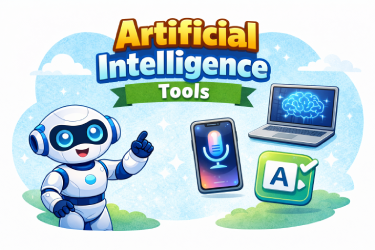
Artificial Intelligence tools are smart computer programs that help people do work easily and quickly. These tools can understand information and give helpful answers. Many students and workers use AI tools every day.
For example, AI writing tools help people write stories and homework. AI image tools create pictures from simple ideas. Voice assistants listen to your voice and answer questions. Translation tools change one language into another language.
AI tools save time and make work simple. They help students learn better and help teachers and workers finish tasks faster. In the future, AI tools will become more useful and help people in many new ways.
- ChatGPT helps people write, learn, and solve homework problems using natural language models.
- Artificial intelligence detectors help teachers and companies check if content was AI-written.
- Voice assistants like Siri and Alexa answer questions, play music, and control smart devices.
- AI-powered apps edit photos, make presentations, and even write code.
These tools save time, improve productivity, and open new ways to work.
Conclusion
Artificial Intelligence is not a dream of the future. It is already here and shaping daily life. From ChatGPT to AI detectors, AI influences how we live, learn, and work.
By understanding reasoning, problem-solving, and knowledge representation, we see that AI is more than machines. It is a partner that helps us solve problems and create opportunities.
The AI world is growing quickly, and keeping up with artificial intelligence news will help us adapt to the future.
FAQs: Artificial Intelligence Overview, Tools and Future
1. What is Artificial Intelligence?
Artificial Intelligence or AI is a smart technology that helps computers think and learn like humans. It helps machines understand information and make decisions.
2. Where do we use Artificial Intelligence in daily life?
We use AI in mobile phones video apps smart assistants online maps and learning apps. AI helps make daily tasks easy and fast.
3. What are Artificial Intelligence tools?
AI tools are computer programs that help people write create images search information and solve problems quickly.
4. How do AI tools help students?
AI tools help students learn new topics practice questions and find answers easily. They make learning simple and fun.
5. Will Artificial Intelligence be important in the future?
Yes AI will become more important in the future. It will help in education health transport and many other fields.
6. Can Artificial Intelligence replace humans?
AI helps humans but does not fully replace them. Humans still control and guide AI systems.8




- Be Respectful
- Stay Relevant
- Stay Positive
- True Feedback
- Encourage Discussion
- Avoid Spamming
- No Fake News
- Don't Copy-Paste
- No Personal Attacks
- Be Respectful
- Stay Relevant
- Stay Positive
- True Feedback
- Encourage Discussion
- Avoid Spamming
- No Fake News
- Don't Copy-Paste
- No Personal Attacks
