How Artificial Intelligence Works Step by Step Smart Guide
Published: 19 Feb 2026
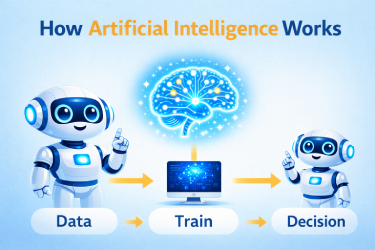
Have you ever wondered how machines can think and learn like humans? Today technology is growing very fast and Artificial Intelligence is becoming part of our daily life. From mobile voice assistants to video recommendations AI is working quietly in the background. But many people still ask one simple question. How Artificial Intelligence Works and how computers make smart decisions.
In this guide you will learn the basic idea of AI in very easy words. We will explain each step clearly so beginners can understand without technical knowledge. You will also see real life examples that show how AI helps people every day. Ready to discover how smart machines actually work? Let us start learning together.
Table of Contents
What Is AI
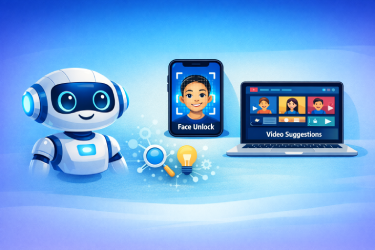
Artificial Intelligence or AI means machines that can think and learn like humans. A computer normally follows fixed instructions. AI is different because it learns from data and improves with experience. AI studies patterns and then makes decisions based on what it learns. For example your mobile phone can unlock using your face. This happens because AI recognizes your image. Another example is video suggestions on streaming apps. AI watches your behavior and suggests content you may like.
AI does not have feelings or emotions. It works using data and smart programs created by humans. The goal of AI is to help people complete tasks faster and more accurately. Today AI is used in education business healthcare and entertainment. When people ask How Artificial Intelligence Works they are really asking how machines learn from information and act smartly. Understanding AI starts with knowing that it is simply software trained to think using data.
How Artificial Intelligence Works Step by Step
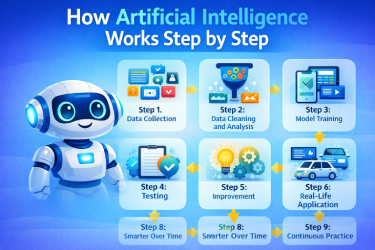
Data Collection
AI starts by collecting different types of data. This can include images, text, voice recordings, or numbers. The more data AI gets, the better it can learn. Data is the foundation of AI. Without enough quality data, AI cannot understand patterns or make accurate decisions.
Data Cleaning and Analysis
After collecting data, AI cleans it by removing errors or unnecessary information. Then it studies the data to find patterns. For example, AI looks for common features in pictures or repeated trends in text. Clean and organized data ensures AI learns correctly and makes better predictions.
Model Training
Engineers train AI by feeding it examples. This is called model training. AI studies these examples to understand patterns and relationships in the data. For instance, showing thousands of cat and dog images helps AI learn to recognize them. Training teaches AI how to respond in new situations.
Testing
Once trained, AI tests what it learned. It makes predictions and checks if they are correct. This step helps AI identify mistakes and weak areas. For example, a spam filter checks whether emails are spam or safe. Testing ensures AI can perform accurately in real-life situations.
Improvement
AI continuously improves by learning from its mistakes. Every wrong prediction helps it adjust algorithms for better results next time. This process is called machine learning. Improvement makes AI smarter over time. The system learns to make more precise decisions and perform tasks faster and more efficiently.
Real-Life Application
After learning, AI can be applied in real life. Examples include spam filters, voice assistants, and recommendation systems. AI observes patterns in user behavior and provides helpful solutions. This shows How Artificial Intelligence Works to assist humans in daily tasks without direct supervision or constant human input.
Independent Decisions
Trained AI can make decisions on its own. For instance, self-driving cars decide when to stop, turn, or speed up. AI systems do not need humans to guide every step. They use the knowledge learned from data to act independently and perform complex tasks accurately.
Smarter Over Time
AI gets smarter the more it is used. With new data, AI recognizes patterns faster and makes better decisions. For example, streaming apps suggest better movies as they learn user preferences. This shows AI’s ability to learn continuously and adapt to changing situations efficiently.
Continuous Practice
AI works like a student practicing every day. Feedback from results helps AI refine its knowledge. Each task completed teaches AI something new. Over time, it becomes more accurate and reliable. Continuous practice ensures AI can handle more complex problems and improve performance constantly.
Simple Examples of AI
- Voice assistants on phones listen and answer questions using AI.
- Navigation apps suggest the fastest route by analyzing traffic data.
- Online shopping websites recommend products based on your searches.
- Streaming platforms suggest movies by learning your watching habits.
- Email services filter unwanted messages automatically.
- Camera apps improve photos using AI image processing.
- Translation apps convert one language into another instantly by comparing millions of sentences.
- Banks use AI to detect unusual transactions and protect users from fraud.
- AI studies user behavior and gives helpful results quietly in the background.
- These real-life examples show that AI is already part of daily routines, saving time and helping make better decisions.
Types of AI
- Narrow AI – Performs one specific task like voice recognition, recommendations, or spam filtering. Most AI today belongs to this type. It cannot do anything outside its task.
- General AI – Aims to think and learn like humans across many tasks. It can understand, reason, and solve different problems, but it does not fully exist yet.
- Super AI – A future concept where machines could become smarter than humans. This type could outperform humans in all areas, including creativity, decision-making, and problem-solving.
- Supervised Learning – AI learns from labeled data, meaning humans provide examples with correct answers. It predicts outcomes using this guidance.
- Unsupervised Learning – AI finds patterns in data without labels. It groups similar information or discovers hidden trends automatically.
- Reinforcement Learning – AI learns by trial and error, receiving rewards or penalties. It improves decisions over time based on outcomes.
Daily Life Uses of AI
AI is part of our daily life even if we don’t notice it. Smartphones use AI for face unlock, voice typing, and improving photos. Social media shows posts based on what you like. Maps suggest faster routes using traffic data.
Smart home devices control lights, temperature, and security automatically. Chatbots answer questions instantly without humans. Health apps track fitness and give advice. Schools use AI tools for personalized learning. Shopping apps suggest products you might like.
These examples show How Artificial Intelligence Works every day. AI studies behavior, finds patterns, and gives helpful solutions. It does not replace humans but supports daily tasks and makes technology easier for everyone.
Final Thoughts
Artificial Intelligence is no longer just a complex idea for scientists. It is a practical technology used every day. From smartphones to online services, AI helps people complete tasks faster and smarter. Learning How Artificial Intelligence Works makes technology easier to understand and less confusing for everyone.
AI studies data, finds patterns, and improves through practice. It acts as a smart helper, not a replacement for humans. Understanding AI basics helps beginners use technology confidently and prepares them for future opportunities in education and careers.
FAQ
1. What is Artificial Intelligence in simple words
Artificial Intelligence is technology that lets machines learn from data and make smart decisions similar to humans in daily tasks and problem solving.
2. How Artificial Intelligence Works
AI collects data, finds patterns, trains models, tests results, and improves through feedback and practice. This step-by-step learning allows machines to perform tasks intelligently.
3. Where is AI used today
AI is used in smartphones, healthcare, education, banking, shopping, and entertainment platforms. It helps make tasks faster, smarter, and more convenient for users.
4. Is AI dangerous for humans
AI is safe if used responsibly. Following human rules, ethics, and proper supervision ensures AI helps without causing harm or risks.
5. Can beginners learn AI easily
Yes, beginners can learn AI by starting with simple concepts, easy examples, and basic explanations. Gradual learning builds understanding step by step.





- Be Respectful
- Stay Relevant
- Stay Positive
- True Feedback
- Encourage Discussion
- Avoid Spamming
- No Fake News
- Don't Copy-Paste
- No Personal Attacks
- Be Respectful
- Stay Relevant
- Stay Positive
- True Feedback
- Encourage Discussion
- Avoid Spamming
- No Fake News
- Don't Copy-Paste
- No Personal Attacks
