Percept in Artificial Intelligence Easy Concept to Know
Published: 24 Dec 2025
Artificial Intelligence, or AI, is everywhere today. From smartphones to smart homes, AI helps machines understand and respond to the world. But have you ever wondered how machines “see” or “hear”? How do they know what is happening around them?
The answer is percept. A percept is the information that AI receives from its environment. Without percepts, AI cannot make decisions or take action. Learning about percept in artificial intelligence is easy and very useful, especially for beginners and students.
In this guide, we will explain percept in simple words. We will use examples from real life. By the end, you will clearly understand what percept is, how it works, and why it is important.
Table of Contents
What is Percept in Artificial Intelligence?
A percept is the input that an AI system receives from its sensors. Sensors are like the eyes, ears, and skin of a machine. They collect information from the environment.
For humans, perception comes naturally. We see, hear, touch, smell, and taste. These senses give us information. AI works similarly but through sensors. For example:
- A camera gives AI a visual percept
- A microphone gives AI an audio percept
- A temperature sensor gives AI a heat percept
Think of a self-driving car. Its cameras see the road, traffic lights, and other vehicles. Its radar detects obstacles. These inputs are all percepts. The AI system uses these percepts to decide how to drive safely.
So, percept in artificial intelligence is simply what the machine senses from the world.
Types of Percepts in AI
AI systems can receive many types of percepts. Let’s explore them one by one with simple examples:
1. Visual Percepts
Visual percepts come from cameras or image sensors. They help AI see objects, people, and environments.
Example: A security camera detects motion. The AI system receives visual percepts and can trigger an alarm if needed.
2. Audio Percepts
Audio percepts come from microphones. They help AI hear sounds.
Example: Voice assistants like Alexa or Siri listen to commands. The audio percept is the sound of your voice.
3. Touch and Temperature Percepts
Robots and machines can sense touch and temperature. Sensors help them feel objects or detect heat changes.
Example: A robot in a factory detects if an object is too hot. The touch and temperature percept helps it avoid accidents.
4. Other Sensor Percepts
AI can also receive data from sensors like GPS, pressure, humidity, or motion.
Example: A drone uses GPS percepts to know its exact location.
By using all these percepts together, AI understands the environment better.
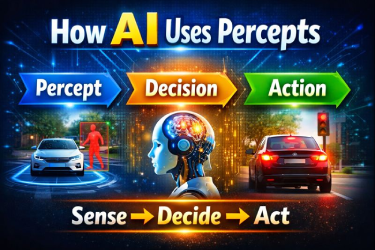
How AI Uses Percepts
A percept is just information. By itself, it does not do anything. AI needs to process percepts to take meaningful action. Think of it like this: a camera sees an image, but the image alone does not move the machine. AI needs to understand the percept and decide what to do next.
The process has three main steps:
1. Percept – AI Senses Something
This is the first step. AI collects information from the environment using its sensors.
Examples:
- A self-driving car’s camera sees a red traffic light.
- A voice assistant hears you say, “Play music.”
- A temperature sensor detects that a room is too hot.
Here, the AI only receives data. It has not acted yet. This is just perception.
2. Decision – AI Decides What to Do
Once AI has the percept, it processes the information using its algorithms. It decides the best action based on the percept.
Examples:
- Self-driving car sees the red light → decides to stop.
- Voice assistant hears “Play music” → decides which song to play.
- Thermostat sensor detects heat → decides to turn on the fan.
Here, AI is thinking logically, but automatically. It follows rules or patterns programmed by developers.
3. Action – AI Acts Based on the Decision
After deciding, AI performs an action. This is the final step where the percept leads to real-world results.
Examples:
- The car stops at the red light.
- The voice assistant plays your requested song.
- The fan turns on to cool the room.
Without percepts, AI cannot take action. Without decision-making, percepts are useless. The combination of percept → decision → action is how AI works in daily life.
This step-by-step use of percepts is the foundation of artificial intelligence.
Percept vs Human Perception
Humans perceive naturally. AI perceives through sensors.
Differences:
- Humans can understand complex emotions. AI cannot.
- Humans perceive with five senses. AI uses sensors for sight, sound, and touch.
- Humans can adapt easily. AI needs programming to interpret percepts.
Example: You see a ball rolling. Your brain understands its speed and direction automatically. A self-driving car needs visual sensors and algorithms to interpret the same ball.
This shows why percepts are crucial for AI.
Importance of Percepts in AI
Percepts are the eyes and ears of AI. They give AI information about the world. Without percepts, AI would be blind and deaf. It cannot understand what is happening around it.
Key points:
- They help AI understand the environment
- They guide AI decisions
- They prevent mistakes by providing accurate input
Example of failure:
If a camera in a self-driving car fails to capture a red light, the AI may not stop. This can cause an accident. Accurate percepts are essential.
Real-Life Applications of Percepts in AI
Percepts are everywhere in AI systems. Here are some examples:
1. Self-Driving Cars
- Cameras and radars provide visual and distance percepts
- AI processes percepts to navigate safely
2. Smart Home Devices
- Microphones detect voice commands
- Sensors detect temperature and motion
- AI adjusts lights, music, or thermostat
3. Factory Robots
- Robots sense object shapes and positions
- They pick and place items accurately using percepts
4. Health Monitoring Devices
- Wearable devices sense heart rate, steps, and sleep patterns
- AI provides health suggestions based on percepts
Real-life examples make it easy to understand how important percepts are.
Common Challenges with Percepts
AI systems face some challenges with percepts.
1. Sensor Errors
Sensors may fail or give wrong information.
2. Misinterpretation of Data
AI may misread percepts if algorithms are not accurate.
3. Environmental Issues
Poor lighting, noise, or obstacles can affect percepts.
Tips to Improve Accuracy:
- Use multiple sensors together
- Clean and maintain sensors
- Train AI with real-life data
These steps help AI make better decisions.
How Beginners Can Understand and Learn Percepts
Beginners can try simple exercises to understand percepts.
1. Visual Exercise:
Take a camera and capture different objects. Observe how AI can detect shapes and colors.
2. Audio Exercise:
Use a microphone and record simple commands. Use free AI tools to see how it recognizes speech.
3. Mini-Projects:
- Make a simple motion detector using a webcam
- Build a voice command project using Python or Scratch
Tips for Students:
- Focus on real-life examples
- Learn sensors and their types
- Practice small projects to see percepts in action
This hands-on approach helps beginners understand percept in artificial intelligence quickly.
Conclusion
Percept in Artificial Intelligence is an easy and important concept. It is the information AI receives from its environment. Percepts allow AI to sense, decide, and act.
We learned:
- Percepts come from sensors like cameras and microphones
- AI uses percepts to make smart decisions
- Percepts are different from human perception
- Real-life examples include self-driving cars, robots, and smart devices
- Beginners can use exercises and mini-projects to learn percepts
Understanding percept is essential for anyone learning AI. It is the first step to making machines smart.
By practicing and observing percepts in real-life examples, you can easily master this concept. Start small, try projects, and notice how AI uses percepts every day.
Now you know the easy concept of percept in artificial intelligence. Are you ready to explore AI further?
Frequently Asked Questions (FAQ)
Q1: What is a percept in artificial intelligence?
A percept is the information that AI receives from its environment through sensors. It helps AI understand what is happening and decide what to do next.
Q2: Why are percepts important in AI?
Percepts are important because AI cannot act without them. They guide decisions and help machines respond accurately to the environment.
Q3: What are examples of percepts in AI?
Examples include:
- Camera images in self-driving cars
- Voice commands for smart assistants
- Temperature and touch sensors in robots
- GPS signals in drones
Q4: How is percept different from human perception?
Humans perceive naturally with senses like sight and hearing. AI perceives through sensors and algorithms. AI cannot understand emotions or context like humans.
Q5: Can beginners learn about percepts easily?
Yes. Beginners can start with small exercises like using cameras, microphones, or simple AI tools. Mini-projects help understand how percepts work in real life.
Q6: What is the process of using percepts in AI?
The process is simple:
- AI senses the environment (percept)
- AI makes a decision based on percept
- AI performs an action
Q7: Where are percepts used in real life?
Percepts are used in:
- Self-driving cars
- Smart home devices
- Robots in factories
- Health monitoring wearables
Q8: How can AI percepts fail?
Percepts can fail due to:
- Faulty sensors
- Poor environment conditions
- Incorrect data interpretation
Q9: How can AI percepts be improved?
Tips to improve percepts:
- Use multiple sensors together
- Maintain and clean sensors
- Train AI with real-life examples
Q10: Is percept in artificial intelligence only for experts?
No. Percepts are a basic AI concept. Beginners, students, and hobbyists can easily understand and use this concept.





- Be Respectful
- Stay Relevant
- Stay Positive
- True Feedback
- Encourage Discussion
- Avoid Spamming
- No Fake News
- Don't Copy-Paste
- No Personal Attacks
- Be Respectful
- Stay Relevant
- Stay Positive
- True Feedback
- Encourage Discussion
- Avoid Spamming
- No Fake News
- Don't Copy-Paste
- No Personal Attacks
