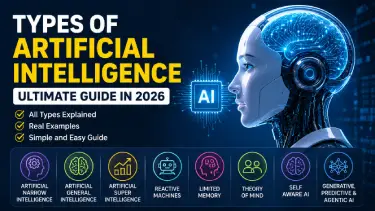
Types of Artificial Intelligence Ultimate Guide in 2026
Published: 18 Jul 2026
Artificial intelligence is changing the world faster than ever. It helps people work smarter, learn faster, and solve problems more easily. Today, AI is part of many daily activities. You can see it in smartphones, search engines, online shopping, healthcare, banking, and social media.
Many people know about AI, but they do not understand the different types of artificial intelligence. Every AI system is designed for a specific purpose. Some AI systems can recognize images. Others can answer questions, recommend products, or create new content.
Learning the types of artificial intelligence helps you understand how modern technology works. It also helps you know why some AI tools are more advanced than others.
Table of Contents
Definition of Artificial Intelligence
The definition of artificial intelligence is simple. Artificial intelligence is a technology that allows computers and machines to perform tasks that normally require human intelligence.
These tasks include learning, problem solving, understanding language, recognizing images, making decisions, and finding patterns in data.
Unlike traditional software, AI can improve its performance by learning from information. This makes it more useful for solving real world problems.
What Are the Types of Artificial Intelligence
Experts usually divide the types of artificial intelligence into three main groups.
- Types of Artificial Intelligence by Intelligence and Capability
- Types of Artificial Intelligence by Function and Behavior
- Types of Artificial Intelligence by Practical Output and Utility
Each group focuses on a different aspect of AI. Together, they provide a complete understanding of modern artificial intelligence.
Types of Artificial Intelligence by Intelligence and Capability
This classification explains AI based on its level of intelligence and capability. It includes three important types of artificial intelligence.
Artificial Narrow Intelligence
Artificial Narrow Intelligence, also called ANI or Weak AI, is the most common AI used today.
This type of AI is designed to perform one specific task. It cannot think like a human or perform tasks outside its programmed purpose.
For example, ChatGPT answers questions, Google Translate translates languages, and Face Unlock recognizes faces. Each system performs a specific job very well, but it cannot do everything.
Most AI tools available today belong to Artificial Narrow Intelligence.
Artificial General Intelligence
Artificial General Intelligence, also called AGI or Strong AI, is an advanced form of AI that researchers hope to develop in the future.
Unlike ANI, AGI would be able to learn different skills, understand new situations, and solve many kinds of problems without special programming.
Imagine one AI system that can teach students, drive a car, write a book, diagnose diseases, and create software. That is the goal of Artificial General Intelligence.
At present, no true AGI system exists.
Artificial Superintelligence
Artificial Superintelligence, also known as ASI, is a theoretical concept.
This type of AI would be more intelligent than humans in every field. It could solve difficult scientific problems, invent new technologies, and make better decisions than the smartest experts.
Some researchers believe Artificial Superintelligence could improve healthcare, education, and science. Others believe it may create challenges if people cannot control it safely.
Today, Artificial Superintelligence remains a future idea and has not been created.
Types of Artificial Intelligence by Function and Behavior
This classification explains how AI behaves and how it responds to information. These types of artificial intelligence show the level of thinking and learning an AI system can achieve. There are four main categories.
Reactive Machines
Reactive Machines are the simplest types of artificial intelligence. They do not remember past events or learn from previous experiences. They only react to the information they receive at that moment.
For example, a chess playing AI checks the current position of the pieces before making the next move. It does not remember earlier games or improve itself over time. It simply follows the rules and chooses the best possible action.
Reactive Machines work well for specific tasks, but they cannot make decisions based on past experiences.
Limited Memory
Limited Memory AI is the most common type of artificial intelligence used today. It can learn from past data for a short time and use that information to make better decisions.
Self driving cars are a good example. They monitor nearby vehicles, traffic signals, road signs, and speed. This information helps them drive safely and avoid accidents.
Virtual assistants, recommendation systems, and many modern AI tools also use Limited Memory. ChatGPT is based on advanced AI models that fall under this category because they process information to generate useful responses.
Theory of Mind
Theory of Mind AI is a future concept. It aims to understand human emotions, thoughts, beliefs, and intentions.
If this technology becomes successful, AI will know how people feel and adjust its responses in a natural way. For example, an AI teacher could recognize when a student is confused and explain the lesson in a simpler way.
Scientists are still researching this type of artificial intelligence. It is not available in real world applications yet.
Self Aware AI
Self Aware AI is the most advanced idea in artificial intelligence. This type of AI would have its own awareness, emotions, and understanding of itself.
A Self Aware AI system could think independently and understand its own actions. It would behave more like a human than a machine.
Today, Self Aware AI exists only as a theoretical concept. No company or research organization has developed such a system.
Types of Artificial Intelligence by Practical Output and Utility
This classification focuses on what AI produces and how people use it in daily life. These are the most popular types of artificial intelligence in modern technology.
Generative AI
Generative AI creates new content instead of only analyzing information. It can write articles, generate images, create videos, produce music, and write computer code.
Popular examples include ChatGPT, Google Gemini, Claude, and Microsoft Copilot. Millions of people use these tools for learning, business, and content creation.
Generative AI is one of the fastest growing fields in artificial intelligence because it saves time and improves productivity.
Predictive AI
Predictive AI studies past data to predict future results. It finds patterns and estimates what is likely to happen next.
Online shopping websites recommend products based on your previous purchases. Banks detect unusual transactions to reduce fraud. Weather applications predict future weather conditions using historical data.
Businesses use Predictive AI to make smarter decisions and reduce risk.
Agentic AI
Agentic AI is designed to complete tasks with very little human guidance. It can plan, make decisions, and perform multiple actions to achieve a goal.
For example, an AI travel assistant could search for flights, compare hotel prices, create a travel plan, and complete bookings after receiving your instructions.
Agentic AI is becoming more powerful as technology continues to improve.
Machine Learning and Deep Learning
Machine Learning is a branch of artificial intelligence that allows computers to learn from data without being programmed for every task.
Deep Learning is a more advanced part of Machine Learning. It uses neural networks to solve complex problems such as speech recognition, image recognition, and language understanding.
For example, facial recognition on smartphones, voice assistants, medical image analysis, and language translation all use Machine Learning and Deep Learning.
These technologies are the foundation of many modern AI systems and continue to shape the future of artificial intelligence.
Conclusion
The types of artificial intelligence help us understand how modern AI systems work and why each one has a different purpose. Some AI systems perform a single task, while others can learn from data or create new content.
Today, Artificial Narrow Intelligence is the most common type of AI. It powers tools such as ChatGPT, Google Maps, Netflix, and virtual assistants. Researchers continue to work on more advanced AI, including Artificial General Intelligence and Artificial Superintelligence, but these technologies are still under development.
As AI continues to grow, understanding the different types of artificial intelligence will help you use AI tools more effectively and prepare for future innovations.
Frequently Asked Questions
What are the 4 types of artificial intelligence?
The four main types of artificial intelligence based on function and behavior are Reactive Machines, Limited Memory, Theory of Mind, and Self Aware AI. These categories explain how AI learns, remembers information, and makes decisions.
Who is the father of AI?
John McCarthy is known as the father of artificial intelligence. He introduced the term “Artificial Intelligence” in 1956 and helped establish AI as a field of computer science.
What 5 jobs will AI not replace?
AI is unlikely to replace jobs that require creativity, emotional intelligence, leadership, and human interaction. Examples include teachers, doctors, psychologists, social workers, and business leaders.
What is artificial intelligence in simple words?
Artificial intelligence is technology that enables computers and machines to perform tasks that normally require human intelligence. These tasks include learning, solving problems, understanding language, and making decisions.
Which type of AI is ChatGPT?
ChatGPT is Artificial Narrow Intelligence because it focuses on language related tasks. It is also a Generative AI system that creates new content from user prompts.
What are 5 examples of AI?
Five common examples of AI are ChatGPT, Google Maps, Siri, Netflix recommendations, and Google Translate. These tools help people complete everyday tasks more efficiently.
What are the 7 branches of AI?
The seven common branches of AI are Machine Learning, Deep Learning, Natural Language Processing, Computer Vision, Robotics, Expert Systems, and Fuzzy Logic.
What is deep learning AI?
Deep Learning is a branch of artificial intelligence that uses neural networks to learn from large amounts of data. It powers technologies such as image recognition, speech recognition, and language generation.
What are 10 types of AI?
Ten popular types of artificial intelligence include Artificial Narrow Intelligence, Artificial General Intelligence, Artificial Superintelligence, Reactive Machines, Limited Memory, Theory of Mind, Self Aware AI, Generative AI, Predictive AI, and Agentic AI.
What is the big 4 of AI?
The big four categories often refer to Artificial Narrow Intelligence, Artificial General Intelligence, Artificial Superintelligence, and Generative AI because these are the most widely discussed AI concepts today.
How many types of AI are there currently?
There is no single official number because AI can be classified in different ways. The most common classifications include three capability based types, four function based types, and several practical AI categories such as Generative AI and Predictive AI.
Is ChatGPT narrow or General AI?
ChatGPT is Artificial Narrow Intelligence. It is designed to understand and generate language, but it does not have human level intelligence or the ability to perform every task like Artificial General Intelligence.





- Be Respectful
- Stay Relevant
- Stay Positive
- True Feedback
- Encourage Discussion
- Avoid Spamming
- No Fake News
- Don't Copy-Paste
- No Personal Attacks
- Be Respectful
- Stay Relevant
- Stay Positive
- True Feedback
- Encourage Discussion
- Avoid Spamming
- No Fake News
- Don't Copy-Paste
- No Personal Attacks
