Agentic AI vs Earlier AI: From Answers to Actions
Published: 4 Aug 2026
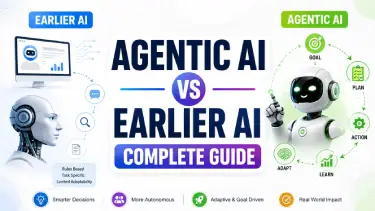
What if AI could do more than simply follow your instructions? Earlier AI systems could answer questions, translate languages, or recommend products, but they usually needed humans to guide each step. Today, a new approach called Agentic AI is changing how artificial intelligence works.
Artificial intelligence has changed the way people work, learn, and solve problems. Earlier AI systems were built to perform specific tasks based on human instructions. They worked well for many useful applications, but they had limited ability to plan and act on their own.
Understanding Agentic AI vs Earlier AI is important because modern AI can plan tasks, make decisions, use tools, and work toward goals with less human support. Instead of responding to one command at a time, Agentic AI can handle multiple steps to complete a task.
In this guide, you will learn the key differences between Agentic AI and Earlier AI in simple words. You will also see real world examples, important features, benefits, limitations, and practical use cases.
Table of Contents
What Is Agentic AI?
Agentic AI is an advanced type of artificial intelligence that can work toward a goal without needing instructions for every step. It can understand a task, create a plan, make decisions, and take action while adapting to new information. This makes it more independent than earlier AI systems, which normally wait for user commands before doing anything.
For example, if you ask an Agentic AI to organize a business meeting, it can find a suitable date, schedule the meeting, send invitations, prepare reminders, and update the calendar automatically. This ability makes Agentic AI valuable in industries such as healthcare, finance, software development, customer support, and business management because it saves time and improves productivity.
What Is Traditional AI?
Traditional AI refers to earlier artificial intelligence systems that perform specific tasks using predefined rules or trained data. These systems are designed for one purpose and usually cannot go beyond their assigned job. They respond to user requests but cannot create their own plans or complete complex workflows without human guidance.
Common examples of Traditional AI include spam filters, language translators, recommendation systems, and basic chatbots. These tools are useful for everyday tasks, but they stop working after completing the requested action. Unlike Agentic AI, they cannot make independent decisions or manage multiple tasks at the same time.
How Is Agentic AI Different from Earlier Forms of AI?
The biggest difference in Agentic AI vs Earlier AI is autonomy. Earlier AI systems focus on completing one task at a time and depend on users for every new instruction. They follow fixed workflows and cannot easily adapt when conditions change. This limits their ability to solve complex problems that require planning and decision making.
Agentic AI works toward a goal instead of waiting for continuous commands. It can analyze information, create a strategy, use different tools, and adjust its actions based on new situations. For example, a traditional AI chatbot only answers customer questions, while an Agentic AI assistant can answer questions, create support tickets, schedule follow ups, and monitor progress automatically. This makes Agentic AI more flexible, efficient, and suitable for modern business needs.
Agentic AI vs Traditional AI Key Differences
The main difference between Agentic AI and Traditional AI is the way they perform tasks. Traditional AI follows predefined rules and completes only the task it has been trained to do. It waits for user input before taking action and cannot continue working after the task is finished. This makes it reliable for simple and repetitive jobs, but less effective for complex workflows.
| Feature | Agentic AI | Traditional AI |
|---|---|---|
| Goal | Works toward a complete goal | Completes one specific task |
| Decision Making | Makes decisions independently | Follows predefined rules |
| Human Involvement | Needs very little human guidance | Depends on user instructions |
| Planning | Creates and follows a multi step plan | Does not plan ahead |
| Adaptability | Adjusts to new situations automatically | Struggles with unexpected changes |
| Learning | Uses feedback to improve actions | Limited to trained data or rules |
| Task Management | Handles multiple connected tasks | Performs one task at a time |
| Tool Usage | Can use multiple tools to complete a goal | Usually works with one function only |
| Flexibility | Highly flexible and goal driven | Limited and task specific |
| Real World Example | AI travel assistant that plans and books an entire trip | Spam filter, calculator, or basic chatbot |
| Best Use Cases | Business automation, AI agents, workflow management | Translation, recommendations, image recognition, spam detection |
| Future Potential | Represents the next generation of intelligent AI | Forms the foundation of earlier AI systems |
Agentic AI works with a goal instead of a single command. It can create a plan, make decisions, use different tools, and adjust its actions when new information appears. For example, a traditional AI can answer customer questions, while an Agentic AI assistant can answer questions, schedule follow ups, create reports, and notify the support team without human guidance. This makes Agentic AI more flexible and productive.
Agentic AI vs Generative AI vs Predictive AI
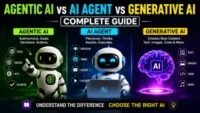
Many people confuse these AI technologies because they all use artificial intelligence, but each one has a different purpose. Generative AI creates new content such as articles, images, videos, and computer code. Predictive AI studies historical data and predicts future outcomes like customer behavior, sales trends, or equipment failures.
Agentic AI goes beyond creating content or making predictions. It combines reasoning, planning, and decision making to complete a goal. For example, an Agentic AI marketing assistant can predict customer interests, generate marketing content, launch a campaign, monitor results, and improve future performance automatically. This ability to complete an entire workflow makes Agentic AI more advanced than many earlier AI systems.
How Is Agentic AI Different from Traditional Automation?
Traditional automation follows a fixed process that never changes unless a person updates the rules. It works well for repetitive tasks such as sending scheduled emails, generating invoices, or moving files between systems. However, it cannot understand changing situations or solve unexpected problems.
Agentic AI is much smarter because it focuses on achieving a goal instead of following fixed instructions. It can analyze new information, change its plan, and make better decisions while completing a task. For example, instead of sending the same email to every customer, an Agentic AI system can personalize messages, choose the best sending time, track customer responses, and improve future campaigns without constant human involvement.
What Happens During the Perception Part of the Agentic AI Loop?
The perception stage is the starting point of the Agentic AI loop. During this stage, the AI gathers information from different sources such as user input, sensors, websites, databases, documents, or cameras. It studies this information to understand the current situation before making any decision or taking action.
For example, a self driving car first observes traffic lights, nearby vehicles, road signs, weather conditions, and pedestrians before deciding how to drive safely. In the same way, an AI business assistant collects information about schedules, emails, and project updates before creating a work plan. Strong perception helps Agentic AI make accurate decisions and perform better than earlier AI systems in real world situations.
Real World Examples of Agentic AI vs Earlier AI
The difference between Agentic AI and earlier AI becomes much clearer when we look at real world examples. Earlier AI usually performs one specific task at a time. A chatbot answers questions, a recommendation system suggests products, and a translation tool converts one language into another. Each system works well within its assigned role, but it cannot manage a complete workflow on its own.
Agentic AI can handle multiple connected tasks while working toward a goal. For example, an AI travel assistant can search for flights, compare hotel prices, create a travel plan, book reservations, and send reminders without needing constant instructions. In healthcare, Agentic AI can review patient records, schedule appointments, suggest treatments, and prepare reports. These examples show why Agentic AI is becoming more valuable than earlier AI systems.
Why Is Agentic AI a Big Deal?
Agentic AI is becoming important because it helps people complete complex tasks faster and with less manual effort. Businesses can improve productivity by allowing AI to manage routine work while employees focus on more valuable responsibilities. This saves time, reduces costs, and improves the overall quality of work.
Another reason Agentic AI is gaining attention is its ability to adapt to changing situations. Unlike earlier AI, it can analyze new information, change its plan, and continue working without waiting for human instructions. As more companies adopt intelligent automation, Agentic AI is expected to become a key technology in healthcare, finance, education, customer service, manufacturing, and many other industries.
The Future of Agentic AI
The future of Agentic AI looks very promising as researchers continue to build smarter and more capable systems. Future AI agents will likely complete more complex projects, work with multiple software tools, and collaborate with people in a more natural way. They may also become better at understanding context, solving problems, and making safe decisions.
However, this growth also brings new challenges. Developers must focus on security, privacy, transparency, and responsible AI practices. Proper human oversight will remain important to ensure AI systems make reliable and ethical decisions. With the right balance between innovation and safety, Agentic AI has the potential to transform the way people live and work.
Conclusion
The comparison of Agentic AI vs Earlier AI shows how artificial intelligence has evolved from simple task based systems to intelligent goal driven assistants. Earlier AI performs specific tasks and depends heavily on user instructions, while Agentic AI can plan, reason, make decisions, and complete multiple actions with minimal human support.
As AI technology continues to advance, Agentic AI will play a bigger role in business, healthcare, education, finance, and many other industries. Learning the differences between these technologies helps you understand where AI is today and what the future of intelligent automation may look like.
Frequently Asked Questions
How Is Agentic AI Different from Earlier Forms of AI?
Agentic AI can plan tasks, make decisions, and complete goals with little human involvement. Earlier AI performs specific tasks and usually waits for user instructions before taking action.
What Is the Difference Between Generative AI and Agentic AI?
Generative AI creates content such as text, images, and code. Agentic AI focuses on completing goals by planning tasks, making decisions, and using different tools when needed.
Are Generative AI and Agentic AI the Same Thing?
No. Generative AI creates new content, while Agentic AI manages tasks and works toward a goal. Agentic AI can even use Generative AI as one of its tools.
What’s the Difference Between AI and an AI Agent?
Artificial intelligence is the broader technology that enables machines to perform intelligent tasks. An AI agent is a system built with AI that can observe, plan, decide, and act to achieve specific objectives.
Is ChatGPT an Agentic AI?
ChatGPT is mainly a Generative AI system. By itself, it is not a fully Agentic AI because it normally responds to user prompts instead of acting independently to complete long workflows.
What Is an Example of an AI Agent?
A customer support assistant that answers questions, creates support tickets, schedules follow ups, and updates records automatically is a good example of an AI agent.
What Are the 5 Different Types of AI?
Five common AI categories are Artificial Narrow Intelligence, Artificial General Intelligence, Artificial Superintelligence, Generative AI, and Agentic AI.
What Are the Key Differences Between Agentic and Agentive Artificial Intelligence?
Agentic AI refers to AI systems that can plan and take actions independently to achieve goals. The word “agentive” is mainly a language term and is less commonly used to describe AI systems.
What Is the Primary Function of the Perception Part of an Agentic AI Loop?
The perception stage collects and analyzes information from the environment. This helps the AI understand the current situation before making decisions or taking action.
Who Are the Big 4 AI Agents?
The term “Big 4 AI Agents” does not have one official definition. However, leading AI agent platforms are commonly associated with solutions developed by OpenAI, Google, Microsoft, and Anthropic.


- Be Respectful
- Stay Relevant
- Stay Positive
- True Feedback
- Encourage Discussion
- Avoid Spamming
- No Fake News
- Don't Copy-Paste
- No Personal Attacks
- Be Respectful
- Stay Relevant
- Stay Positive
- True Feedback
- Encourage Discussion
- Avoid Spamming
- No Fake News
- Don't Copy-Paste
- No Personal Attacks
