Agentic AI vs AI Agent vs Generative AI: Complete Guide
Published: 2 Aug 2026
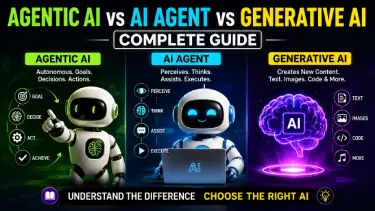
Artificial intelligence is no longer just answering questions or creating content. Today, AI can plan tasks, make decisions, use tools, and complete work with less human help. But with terms like Agentic AI, AI Agent, and Generative AI becoming common, it can be hard to understand what each one actually does.
Agentic AI vs AI Agent vs Generative AI is an important comparison for anyone who wants to understand modern AI. These technologies can look similar, but they have different roles, abilities, risks, and use cases.
In this complete guide, you will learn how Agentic AI, AI Agents, and Generative AI work, how they differ, where they are used, and how they can work together. You will also see simple examples that make these AI concepts easy to understand.
Table of Contents
What Is an AI Agent?
An AI agent is a software system that performs tasks for users or businesses. It collects information, analyzes data, makes decisions, and takes action to achieve a specific goal. Unlike traditional software, an AI agent can adapt to changes instead of only following fixed instructions. For example, on an online shopping website, an AI agent can check an order status and instantly answer a customer’s question without human support.
Key features of an AI agent include observing its environment, making decisions from available data, performing tasks automatically, following a defined goal, and improving efficiency while saving time. Today, AI agents are widely used in healthcare, finance, education, ecommerce, manufacturing, and many other industries because they make work faster and more accurate.
Types of AI Agents
AI agents come in different types. Each type is built to solve a specific kind of problem. Some AI agents follow simple rules. Others learn from experience and make better decisions over time. Understanding these types makes it easier to understand the comparison of Agentic AI vs AI Agent vs Generative AI.
Simple Reflex Agent
A simple reflex agent is the most basic type of AI agent. It responds to the current situation using fixed rules. It does not remember past events or plan for the future.
For example, a smart motion sensor light turns on when it detects movement and turns off when no movement is detected. It only reacts to what it sees at that moment.
Model Based Reflex Agent
A model based reflex agent stores information about its environment. It uses this knowledge to make better decisions when conditions change.
For example, a robot vacuum remembers which rooms it has already cleaned. It avoids cleaning the same area again and moves to the next room.
Goal Based Agent
A goal based agent works to achieve a specific objective. Before taking action, it checks different options and chooses the one that brings it closer to its goal.
For example, a GPS navigation system looks at several routes before suggesting the fastest path to your destination.
Utility Based Agent
A utility based agent compares different choices and selects the one that gives the best result. It focuses on improving efficiency, quality, or user satisfaction.
For example, an airline ticket booking system compares prices, travel time, and seat availability before recommending the best flight.
Learning Agent
A learning agent becomes smarter through experience. It studies previous results and improves its future decisions without being programmed again.
For example, a movie streaming platform learns what you like to watch and recommends better movies over time.
Hierarchical Agent
A hierarchical agent divides a large task into smaller tasks. Different parts of the system work together to complete one overall goal.
For example, a warehouse automation system manages inventory, packing, shipping, and delivery through separate AI agents that work as one team.
A multi agent system includes several AI agents working together. Each agent has a different responsibility, but they cooperate to complete complex tasks.
Multi Agent System
For example, in a smart city, one AI agent controls traffic lights, another monitors public transport, and another manages emergency services. Together they improve traffic flow and public safety.
These different types of AI agents show how automation has evolved over time. Traditional AI agents usually perform one defined role. Modern Agentic AI can combine many of these abilities into one intelligent system. It can plan, reason, adapt, and complete complex workflows with very little human support. This is one of the biggest reasons why the discussion around Agentic AI vs AI Agent vs Generative AI has become so important for businesses and technology professionals.
What Is Agentic AI?
Agentic AI is a more advanced form of artificial intelligence that can plan, reason, make decisions, and complete complex tasks with very little human help. Unlike a basic AI agent that focuses on one task, Agentic AI can manage multiple connected tasks and adjust its actions when situations change. It works with business software, databases, search tools, and other digital systems to complete long workflows.
Its main features include planning multiple steps, making decisions based on changing information, learning from results, working with different tools, and managing complete workflows. Many businesses use Agentic AI for customer service, software development, healthcare, finance, research, and supply chain management. For example, during a holiday sale, Agentic AI can monitor inventory, predict customer demand, adjust prices, answer customer questions, and notify the warehouse to restock products automatically.
From AI Agents to Agentic AI
Artificial intelligence has evolved from simple task automation to intelligent workflow management. Traditional AI agents are useful for handling tasks like answering customer questions, scheduling meetings, and processing payments, but they usually stop after completing one task.
Agentic AI goes further by understanding a larger goal, creating a plan, completing multiple connected tasks, monitoring progress, and adjusting its actions when needed. For example, during a product launch, an AI agent may answer customer questions, while Agentic AI can research the market, prepare a marketing plan, create content, monitor campaign performance, and recommend improvements. This shift has become possible because of better language models, reasoning capabilities, and integration with business software and digital tools.
What’s the Difference Between Agentic AI and AI Agents?
Although Agentic AI and AI agents are closely related, they are not the same. An AI agent is designed to perform a specific task, such as answering customer questions, scheduling meetings, or processing orders. It follows predefined rules and usually handles one task at a time.
Agentic AI is more advanced. It understands a larger goal, creates a plan, manages multiple connected tasks, and adapts when conditions change. Instead of waiting for new instructions after every step, it continues working until the objective is completed.
For example, an AI agent can screen resumes and schedule interviews. Agentic AI can create a job description, post job openings, screen candidates, arrange interviews, compare applicants, prepare reports, and recommend the best candidate with very little human support.
The main difference is that AI agents automate individual tasks, while Agentic AI manages complete workflows. Generative AI creates content, AI agents complete tasks, and Agentic AI plans, reasons, and automates entire processes. Businesses choose the right technology based on their goals.
What Is Generative AI?
Generative AI is a type of artificial intelligence that creates new content such as text, images, videos, code, audio, and music. Instead of only analyzing information, it produces new content based on user prompts. Writers, marketers, designers, developers, and students use Generative AI to save time and improve creativity.
Its key features include creating original content, understanding natural language, writing articles and emails, generating images and code, answering questions, and improving content creation speed. When comparing Agentic AI vs AI Agent vs Generative AI, the difference is simple. Generative AI creates content, AI agents perform specific tasks, and Agentic AI plans, reasons, and manages complete workflows.
Agentic AI vs AI Agent vs Generative AI: Key Differences Comparison Table
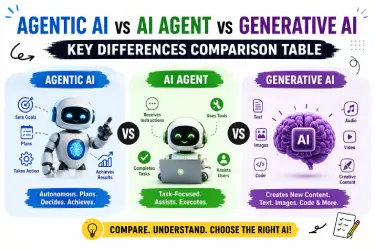
| Feature | AI Agent | Agentic AI | Generative AI |
|---|---|---|---|
| Primary Purpose | Performs specific tasks | Manages complete workflows | Creates new content |
| Main Function | Task automation | Planning, reasoning, and decision-making | Content generation |
| Autonomy | Low to Moderate | High | Low |
| Decision-Making | Follows predefined rules | Makes intelligent and adaptive decisions | Responds to user prompts |
| Planning Ability | Limited | Multi-step planning | No long-term planning |
| Workflow Management | Handles single tasks | Manages end-to-end workflows | Supports individual content requests |
| Learning & Adaptation | Limited learning | Continuously adapts and improves | Improves content based on prompts |
| Human Involvement | Moderate | Minimal | High (prompt-driven) |
| Best Use Cases | Customer support, scheduling, data processing | Business automation, project management, supply chain, research | Writing, image creation, coding, marketing content |
| Example | Customer service chatbot, virtual assistant | Autonomous business assistant, workflow automation system | ChatGPT, AI image generator, AI code assistant |
Five Core Distinctions Between Agentic AI and AI Agents
The biggest difference between these technologies is their level of intelligence and automation.
Level of Autonomy: AI agents complete assigned tasks and usually wait for the next instruction. Agentic AI works independently until the overall goal is achieved.
Decision Making: AI agents make decisions using predefined rules. Agentic AI analyzes more information, compares options, and selects the best strategy.
Planning Ability: AI agents usually focus on one task. Agentic AI breaks large goals into smaller steps and updates its plan whenever new information appears.
Problem Solving: AI agents may stop when unexpected problems occur. Agentic AI can evaluate the situation, find another solution, and continue working.
Business Value: AI agents improve efficiency by automating individual tasks, while Agentic AI improves complete business processes, increases productivity, reduces costs, and supports faster decision-making.
What Is Agentic AI vs. Generative AI?
Agentic AI and Generative AI serve different purposes. Generative AI creates new content such as text, images, videos, code, and audio based on user prompts. It helps users produce content quickly and improve creativity.
Agentic AI goes beyond content creation. It plans, reasons, makes decisions, and completes tasks automatically. It can connect with business tools, monitor progress, and manage complete workflows with minimal human involvement.
For example, Generative AI can create product descriptions and marketing emails, while Agentic AI can research competitors, create a launch strategy, publish campaigns, monitor performance, analyze results, and improve the campaign automatically.
In simple words, Generative AI creates content, while Agentic AI takes action and manages complete workflows. Many businesses combine both technologies to improve productivity and automation.
When to Use Generative AI vs. Agentic AI
The choice depends on your business needs. Use Generative AI when your main goal is creating content such as blog posts, emails, product descriptions, images, code, presentations, or new ideas. It helps users create high quality content quickly and improves productivity.
Use Agentic AI when you need complete automation. It is ideal for managing projects, handling customer support, analyzing business data, coordinating workflows, and making intelligent decisions with minimal human involvement.
Many businesses combine both technologies. Generative AI creates the content, while Agentic AI manages the workflow, schedules tasks, tracks progress, updates records, and prepares reports. This combination saves time, reduces manual work, and improves business efficiency.
Key Use Cases for Agentic AI and AI Agents
AI technologies are used across many industries to improve speed, accuracy, and productivity.
Customer Support: AI agents answer common questions and track orders. Agentic AI manages complete support workflows, while Generative AI creates personalized replies and help articles.
Healthcare: AI agents schedule appointments and manage records. Agentic AI supports patient care and treatment planning, while Generative AI prepares medical reports and educational content.
Finance: AI agents monitor transactions and detect fraud. Agentic AI analyzes financial data and prepares reports, while Generative AI creates summaries and market analysis.
Ecommerce: AI agents recommend products and track deliveries. Agentic AI manages inventory, pricing, and suppliers, while Generative AI writes product descriptions and marketing content.
Software Development: AI agents automate testing and system monitoring. Agentic AI manages development workflows, while Generative AI writes code and documentation.
Education: AI agents answer student questions and organize schedules. Agentic AI creates personalized learning plans, while Generative AI prepares lessons, quizzes, and summaries.
Together, these technologies help businesses reduce costs, improve productivity, and automate daily operations.
The Future of Agentic AI and AI Agents for Automation
Artificial intelligence is moving beyond simple task automation. Businesses now need systems that can manage complete workflows with minimal human involvement, which is driving the growth of Agentic AI.
In the future, more organizations will use Agentic AI with business software, cloud platforms, and databases to automate complex projects. Generative AI will continue creating high quality content, while Agentic AI will use that content to complete larger business goals.
Future AI systems will become more personalized, learn from user behavior, and make better decisions over time. However, organizations must also focus on security, privacy, human oversight, and responsible AI use.
The future is not about one technology replacing another. Generative AI will create content, AI agents will automate specific tasks, and Agentic AI will connect everything into intelligent workflows that deliver faster and better business results.
Conclusion
Understanding Agentic AI vs AI Agent vs Generative AI helps individuals and businesses choose the right technology. AI agents are best for specific tasks, Generative AI is designed for creating content, and Agentic AI manages complete workflows through planning, reasoning, and decision-making.
These technologies work best together. By combining content creation, task automation, and intelligent workflow management, businesses can improve productivity, reduce costs, and deliver better customer experiences. Organizations that understand these differences today will be better prepared for the future of intelligent automation.
Frequently Asked Questions
Is ChatGPT an agent or LLM?
ChatGPT is primarily a Large Language Model. It understands natural language and generates human like responses. By itself, it is not an AI agent because it does not automatically perform tasks in the real world. However, when connected to external tools and given the ability to plan and take actions, ChatGPT can work as part of an AI agent or an Agentic AI system.
What are the 7 types of AI agents?
The seven common types of AI agents are Simple Reflex Agent, Model Based Reflex Agent, Goal Based Agent, Utility Based Agent, Learning Agent, Hierarchical Agent, and Multi Agent System. Each type is designed to solve different kinds of problems and offers different levels of intelligence and decision making.
What are the top 3 AI agents?
Some of the most popular AI agents today include OpenAI Operator, Microsoft Copilot, and Google Project Mariner. These systems help users automate tasks, improve productivity, and interact with different digital tools. New AI agents continue to appear as the technology develops.
Who are the big 4 AI agents?
The leading companies building advanced AI agents are OpenAI, Google, Microsoft, and Anthropic. These organizations invest heavily in artificial intelligence and continue to develop more capable AI systems for businesses and consumers.
Is ChatGPT generative AI or agentic AI?
ChatGPT is mainly Generative AI because its primary role is to create text and answer questions. When it is connected to tools that allow planning, reasoning, and task execution, it can become part of an Agentic AI workflow.
Why are people leaving ChatGPT?
Some users try other AI tools because they need different features, lower costs, stronger privacy, or better performance for specific tasks. Others compare multiple AI platforms to find the one that best matches their work. Many people continue using ChatGPT while also using other AI tools.
Is ChatGPT an intelligent agent?
ChatGPT is not a traditional intelligent agent on its own. It becomes an intelligent agent only when it is connected to software, tools, or automation systems that allow it to perform actions, make decisions, and complete tasks.
Can you give me some examples of AI agents?
Common examples of AI agents include customer service chatbots, virtual assistants, robot vacuum cleaners, fraud detection systems, recommendation engines, warehouse robots, and smart home assistants. These systems perform tasks automatically to help users save time and improve efficiency.
How many AI agents are there?
There is no fixed number of AI agents. Thousands of AI agents exist across different industries. New AI agents are created every day for healthcare, finance, education, ecommerce, manufacturing, software development, and many other fields. The number continues to grow as artificial intelligence becomes more advanced.




- Be Respectful
- Stay Relevant
- Stay Positive
- True Feedback
- Encourage Discussion
- Avoid Spamming
- No Fake News
- Don't Copy-Paste
- No Personal Attacks
- Be Respectful
- Stay Relevant
- Stay Positive
- True Feedback
- Encourage Discussion
- Avoid Spamming
- No Fake News
- Don't Copy-Paste
- No Personal Attacks
